About Combines
Combines represent a type of primarily self-propelled harvester that “combines” all the necessary tasks: reaping or cutting, threshing, and winnowing or cleaning. In other words, it separates the edible, nutritious part of the plant from the stalk, chaff, or straw. The crop is either stored for periodic offloading or continuously conveyed via auger into a grain cart driving next to the combine. The chaff is typically dumped or spread out from the rear of the machine.
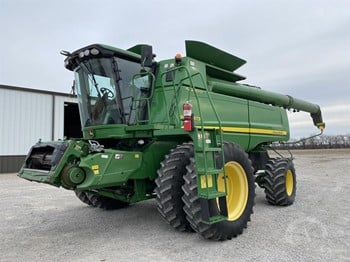
2011 John Deere 9670 STS
Combines are typically diesel-powered and can use a variety of front-mounted heads, or headers, depending on the grain or cereal crop being harvested. For example, row crop headers are designed for inline crops such as corn, while platform or draper heads are optimized for harvesting wheat. Farmers also use combines with headers suitable for oats, barley, soybeans, rice, sorghum, flax, canola, and other crops.
History
The first combine harvesters appeared in the 1800s, drastically improving the amount of work each farmer could do and reducing the number of workers necessary to farm. An American named Hiram Moore developed a livestock-pulled combine harvester in 1835, borrowing ideas from a reaper machine invented by Scotland’s Reverend Patrick Bell several years earlier.
The first self-propelled harvester came about in 1911 thanks to the Holt Manufacturing Company, which would later become famous for its Caterpillar machinery. Case, John Deere, and International Harvester worked on pull-type combines in the following years. Other self-propelled models appeared from Gleaner in 1923, an Argentinian inventor named Alfredo Rotania, in 1929, and notably from Australian Thomas Carroll in 1937 and 1940 (models No. 20 and 21) while working for Massey-Harris.
Important combine improvements include the use of tracks for better flotation across fields and stability on slopes, sidehill leveling capabilities (Raymond Hanson, 1946), unloading augers for emptying the grain into a wagon or truck (Lyle Yost, 1947), continuously variable transmissions to separate forward speed from threshing speed (1950s), self-cleaning rotary screens (mid-1960s), hydrostatic drive systems (1960s), grain loss monitoring (late 1960s), rotary combines (Sperry-New Holland, 1975) and axial-flow models (International Harvester, 1977) with more effective crop separation, and automatic header height and level control (1990s).
Technologies
More recently, manufacturers have developed technologies that let combines automatically compensate for conditions, reduce grain loss, and even guide themselves and a grain cart using GPS data and advanced sensors. Telematics systems allow combines to report data to the farm’s home office, agronomists, and technical support personnel, while remote monitoring allows a farm manager to view the data on the combine’s in-cab screen.
Find The Right Combine Harvester
Popular combine manufacturers with products often up for bidding on AuctionTime include Case IH, Claas, Gleaner, John Deere, Massey Ferguson, and New Holland. Check back often to find the latest combines for sale at auction.

